
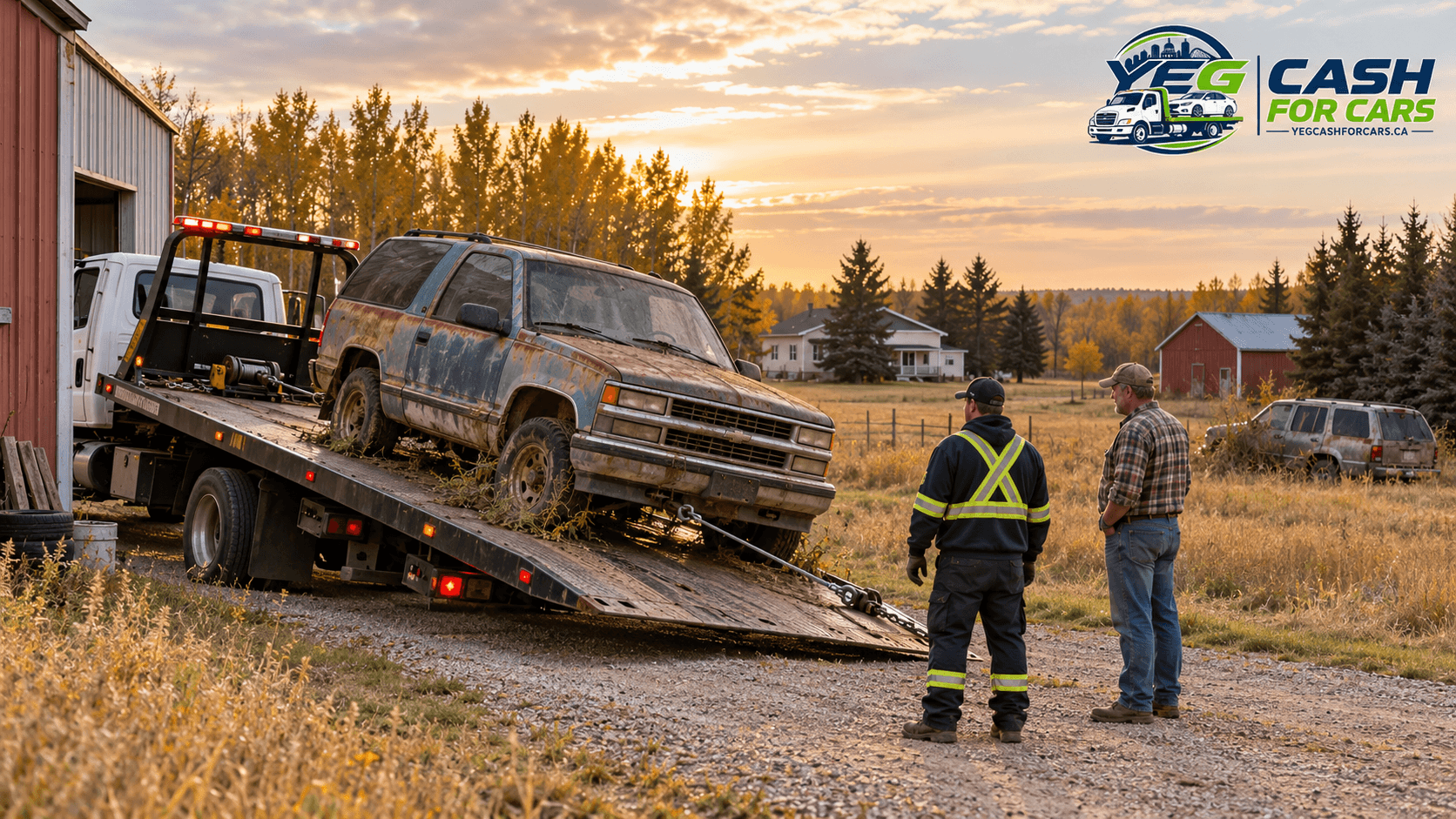
Most acreage vehicle clear-outs happen in a panic. A property sale goes firm, a county letter arrives, or somebody finally trips over the fact that four vehicles have been sitting behind the shelterbelt since the last decade.
Timing it deliberately is worth real money, and the difference is not small. The same four vehicles cleared in late August and cleared in late March are two different jobs, with two different prices and two very different outcomes for your yard.
Here is how to think about when, rather than whether.
The Ground Decides More Than the Calendar
On a town lot, a tow truck arrives and the vehicle leaves. On an acreage, the limiting factor is whether a loaded flatbed can reach the vehicle and get back out without sinking, rutting your yard, or needing a second truck to recover the first.
That makes ground conditions the main variable, and Parkland County gives you roughly four windows a year.
Late spring, after the melt and before things dry. The worst window. Frost is coming out, the ground holds water, and a back field or an unpaved approach turns to soup under weight. Vehicles that have sat all winter are also frozen into place at the start of it.
Summer, once the ground is firm. Good access, and the easiest time to reach vehicles parked away from the driveway. The drawback is that grass and brush are at full height, which hides what is underneath and makes hooking up slower.
Late summer into autumn. The best window by a clear margin. The ground is at its firmest, vegetation has died back, access is straightforward, and you are clearing before snow buries the problem for another six months. If you are planning a multi-vehicle clearance, aim here.
Deep winter, once the ground is frozen hard. Better than people assume, because frozen ground carries weight well. The complications are snow depth, vehicles frozen to the ground, and brakes seized solid, all of which mean winching rather than driving on.
What a Winter of Waiting Actually Costs
The decision most acreage owners make is to leave it until spring. That is the most expensive choice on the list, and it compounds every year it is repeated.
A vehicle outdoors through an Alberta winter loses value in specific, predictable ways. The battery dies and sulfates beyond recovery. Brakes seize to the rotors through repeated thaw and refreeze. Tires flat-spot and eventually go down entirely, which turns a roll-on into a winch job. Rodents move into the engine bay and the cabin, and the wiring damage they do is invisible until somebody tries to assess the vehicle.
Then there is what happens underneath. A vehicle that has sat long enough starts leaking. Engine oil, coolant, transmission fluid, fuel and brake fluid all find their way into the soil beneath, and on an acreage that soil is yours. Clearing a vehicle before it starts weeping is considerably simpler than dealing with contaminated ground afterwards, particularly if you are heading toward a property sale.
Our Stony Plain collection page covers what we take from town lots, farm yards and lake properties, and what each type is typically worth.
Clearing Several Vehicles at Once
If you have more than two, treat it as one planned job rather than a series of separate decisions. It changes both the logistics and the price.
Walk the property first and write down every vehicle, including the ones you have stopped seeing. The pattern on most acreages is two or three obvious candidates near the yard and another one or two further back that have become part of the scenery. Note the year, make and model where you can read them, whether each one rolls, and roughly where it sits relative to a route a truck could take.
Then sort them honestly into three groups. Vehicles you are definitely finished with. Vehicles you are keeping, with a real reason rather than an intention. And projects you have been meaning to get to, which on most properties is the group that needs the most honesty. A project that has not moved in five winters is not a project.
Giving a buyer the whole list at once usually produces a better outcome than calling about one vehicle at a time, because a single trip with the right equipment costs less than three trips with the wrong one.
Access Details Worth Mentioning Upfront
These change what equipment is sent, and getting them wrong means a wasted visit:
- Whether the approach is gravel, grass or dirt, and how it holds up after rain.
- Gate widths, and whether anything needs to be taken down or opened.
- Overhead obstructions such as low branches or a power line crossing the yard.
- Whether vehicles are boxed in behind equipment, bins or other vehicles.
- Soft spots, old septic fields or anything else a loaded truck should not drive over.
- Whether each vehicle rolls freely or has seized brakes and flat tires.
None of these stop a collection. They just determine whether the right truck shows up the first time.
The Paperwork Side
Acreage vehicles are more likely than town vehicles to have paperwork gaps. They have often been off the road for years, and were sometimes bought informally in the first place.
Before the day, establish who is registered to each vehicle, and find what documentation exists. A vehicle bought from a neighbour a decade ago with nothing written down is a different situation from one with a registration in your name in a drawer. Vehicles that came with the property when you bought it are a third case again.
Sort this before booking rather than on the day, because ownership is the one thing that stops a collection outright. Our Alberta car selling paperwork guide sets out what is needed for each situation, including estate vehicles and ones with old liens still registered against them.
Frequently Asked Questions
What is the best month to clear an acreage?
Late August through October. Firm ground, low vegetation, and the vehicles leave before winter rather than after another one.
Can vehicles be collected in winter?
Yes. Frozen ground carries a truck well. Expect winching rather than driving on, and clear snow from around each vehicle beforehand if you can.
Do vehicles need to run or have plates?
No to both. Most acreage vehicles have neither. Plates stay with you in Alberta regardless.
Is it worth clearing one vehicle, or should I wait until I have several?
One is fine. But if you know there are others coming, doing them together is usually the better outcome.
The Short Version
Acreage vehicles do not improve with another winter. They lose their batteries, their brakes, their tires and eventually their fluids into your soil, and each year makes the eventual job harder and the offer smaller.
Plan the clearance for firm ground in late summer or autumn, walk the property and list everything at once, sort the ownership before you book, and mention the access honestly. Our cash for cars Edmonton team collects across Stony Plain and Parkland County, including multi-vehicle clearances from back fields and farm yards, with towing and winching included.