Your old truck has hauled lumber, towed trailers and pushed through more Edmonton winters than you can count. Now it is sitting in the driveway, and you want to know one thing: what is it actually worth? The answer is rarely a single number. Two trucks of the same year can be worth very different amounts depending on a handful of factors buyers check every time.
This guide breaks down exactly what drives the value of an old truck in Edmonton, what lowers it, and what you can do to make sure you get a fair offer.
Why Trucks Are Valued Differently From Cars
Trucks hold a special place in the Alberta market. Contractors, farmers, oilfield workers and weekend campers all rely on them, so demand for used pickups stays strong even when a truck is well past its prime. A worn-out sedan might only be worth its scrap weight, while an older pickup with a solid frame and a working drivetrain can still attract buyers who need a work vehicle or parts.
Trucks are also heavier than cars. A full-size pickup can weigh close to double what a compact car does, which means more recoverable steel even when the truck no longer runs.
The 8 Factors That Set Your Truck's Value
1. Make, Model and Trim
Some trucks are simply in higher demand. Popular full-size models like the Ford F-150, Chevrolet Silverado and Ram 1500, along with midsize favourites like the Toyota Tacoma, tend to keep their value because parts are easy to resell and mechanics know them well. Higher trims with features like crew cabs, longer boxes or towing packages usually bring more than base work models.
2. Engine and Drivetrain
A four-wheel-drive truck is worth more in Edmonton than a two-wheel-drive version of the same model. Buyers here want traction for snow, gravel roads and job sites. Diesel engines can also add value because of their durability and towing strength, but only if they are in good working order. A diesel with serious engine problems can be expensive to repair, which pulls the offer down.
3. Mileage and Engine Hours
High mileage is expected on an old truck, but it still matters. Buyers look at how far the truck has travelled and whether that distance came from highway driving or hard, stop-and-go work use. A truck with high kilometres and a documented maintenance history often outvalues a lower-mileage truck that was neglected.
4. Frame and Rust Condition
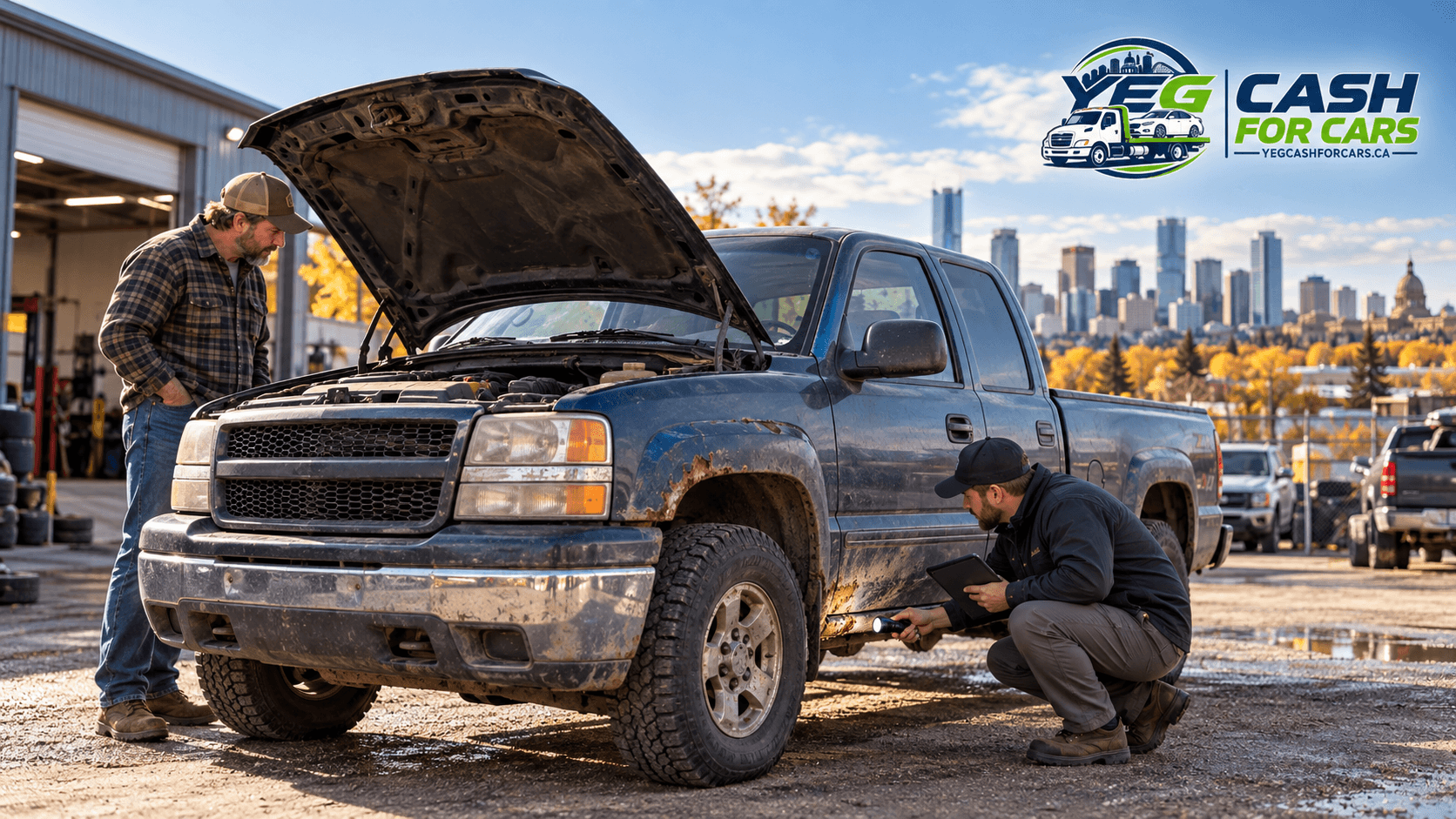
In Edmonton, this is one of the biggest value factors. Road salt and slush eat away at undercarriages, brake lines, rocker panels and truck beds. Surface rust is common and usually acceptable. Frame rot is a different story. A truck with a compromised frame is often unsafe to drive and may only be worth its parts and metal, no matter how good the engine is.
5. Running vs. Non-Running
A truck that starts, drives and stops will almost always bring a better offer than one that does not. That said, a non-running truck is far from worthless. Buyers still pay for usable parts, the catalytic converter and the steel. If your truck is dead in the driveway, you can still get cash for a non-running vehicle without paying for a tow or repair first.
6. Body Damage and Missing Parts
Dents, cracked windshields and hail damage lower the value, but missing parts hurt even more. If the engine, transmission, catalytic converter, wheels or tailgate have been removed, the buyer has less to resell. Always mention missing components when requesting a quote so the price you are given is the price you receive.
7. Modifications
Lift kits, oversized tires, aftermarket bumpers and performance upgrades do not always add value. Some buyers love them, but many prefer stock trucks because they are easier to inspect, insure and repair. Quality work upgrades like a hitch, bed liner or toolbox tend to help more than cosmetic changes.
8. Current Scrap Metal Prices
When a truck is at the end of its road life, its value is closely tied to scrap steel prices, which move up and down with the market. This is why a quote for the same truck can change from one month to the next. Heavier trucks benefit most when metal prices are strong.
What Lowers Your Offer (and How to Avoid It)
Some things that reduce value are within your control.
Missing paperwork. Without registration and proof of ownership, many buyers will lower their offer or walk away. Having your documents ready speeds everything up. Our guide to Alberta car selling paperwork explains exactly what you need.
Unpaid liens. If a loan is still attached to the truck, it must be cleared before the sale. Check for liens early so it does not delay your payment.
Inaccurate descriptions. Understating damage to get a higher quote usually backfires. When the buyer arrives and finds problems that were not mentioned, the offer drops on the spot.
Stripping parts yourself. Pulling the battery, tires or catalytic converter to sell separately often costs you more than it earns, because many buyers price trucks as complete units.
How to Get the Most Money for Your Old Truck
Gather your details first. Note the year, make, model, trim, engine size, drivetrain and approximate kilometres.
Be honest about condition. Share whether it runs, any rust or frame issues, and any missing parts.
Compare a couple of quotes. Offers can vary between buyers, so a quick comparison helps you spot a fair price.
Choose a buyer who removes it for free. Towing a heavy truck can be costly. A buyer offering free towing across Edmonton keeps that cost out of your pocket.
Clean out personal items and remove your plates. In Alberta, plates stay with the owner, and you should cancel insurance once the sale is complete.
Sell Your Old Truck the Easy Way
Whether your pickup still runs every morning or has not moved in years, it has value, and knowing what shapes that value puts you in a stronger position to get paid fairly. YEG Cash for Cars buys old, damaged and unwanted trucks throughout Edmonton and nearby communities, with honest quotes, fast pickup and payment on the spot.
Ready to find out what your truck is worth? Visit our cash for trucks in Edmonton page and request your free quote today.