
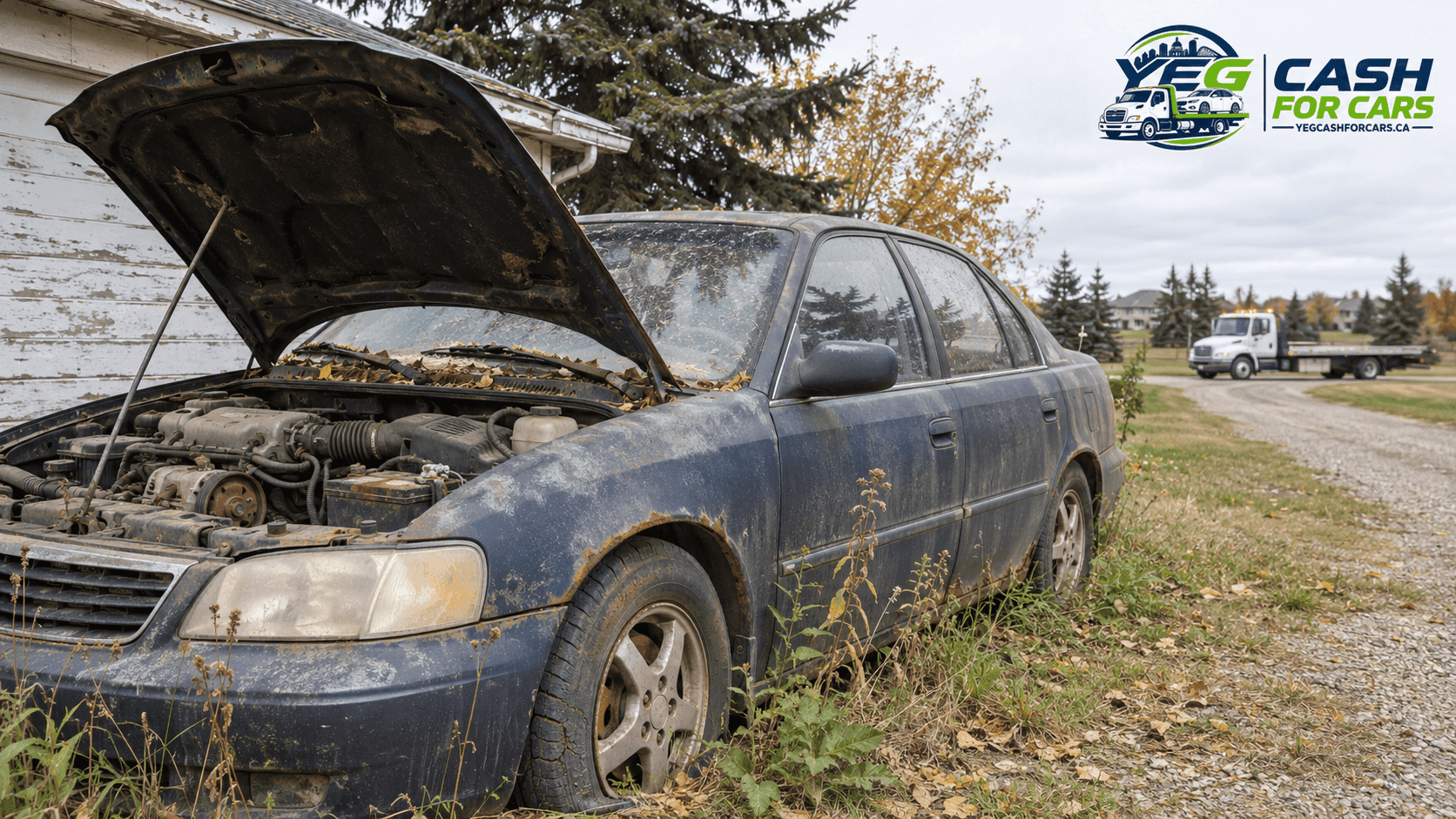
Almost every Edmonton neighbourhood has one: the car under a tarp in the back alley, the sedan that's been in the garage since a parent stopped driving, or the old truck parked behind the shop on an acreage near Stony Plain. It ran when it was parked, so people assume it just needs a boost.
Usually it needs a lot more than that. A car is built to be driven, and sitting is hard on almost every system in it, especially through Edmonton winters. Here's what happens to a parked car over time, what to check before you try to start it, and how to decide whether it's worth bringing back.
What Happens to a Parked Car Over Time
| Time parked | What usually goes wrong |
|---|---|
| 1 to 3 months | The battery runs low, and tires start to lose pressure. |
| 6 months | The battery is often dead, the gas starts to go stale, and the brake rotors rust over. |
| 1 year | Old fuel gums up the system, tires develop flat spots, brakes start to stick, and rodents may move in. |
| 3 years or more | Seals and hoses dry out, tires crack, brake calipers seize, the fuel system needs cleaning or parts, and wiring may be chewed. |
These are typical patterns, not exact timelines. A car stored in a heated garage ages more slowly than one sitting outside through freeze-thaw cycles in a field.
System by System: What Breaks
Battery
A car battery loses charge even when nothing is running, and modern cars draw a little power all the time for their computers and alarms. Within weeks or a few months it's flat. In Edmonton there's an extra risk: a fully discharged battery can freeze and crack in deep cold. A battery that's been dead for a winter usually needs replacing, not charging.
Fuel
Gasoline starts breaking down within months. Over time it leaves a varnish that clogs fuel injectors, filters and pumps. A car that's sat for a few years with old gas in the tank may need the tank drained and parts of the fuel system cleaned or replaced before it runs properly.
Tires
Tires sitting in one spot develop flat spots. After several years the rubber dries out and cracks, even if the tread looks fine. Old, cracked tires aren't safe at highway speed, so plan to replace them.
Brakes
Rust forms on the brake rotors within days of rain or snow. Over months it can cause the pads to stick to the rotors, and calipers can seize. Brake fluid also absorbs moisture over time, which reduces braking performance and corrodes parts from the inside.
Engine Oil, Seals and Hoses
Used oil contains acids and moisture that slowly attack engine parts. Rubber seals, gaskets, belts and hoses dry out and shrink, so a car that didn't leak when it was parked often starts leaking once it runs again.
Rodents
Mice and squirrels love a quiet car, especially in fall when they look for shelter. They build nests in air filter boxes and cabin vents, and they chew wiring. Rodent damage to wiring harnesses can cause electrical faults that are slow and expensive to track down. Acreages and detached garages see this most.
Interior
A small leak around a window or sunroof can lead to damp carpets and mould, which is hard to get rid of completely.
Before You Try to Start It
Don't just put a booster on it and turn the key. That can damage an engine that's been sitting. Check these first:
- Look for nests. Open the hood and the air filter box, and check the cabin air filter.
- Check the oil. If it's low, milky or full of sludge, stop and get it looked at.
- Check the other fluids: coolant, brake fluid and power steering fluid. Look under the car for puddles.
- Inspect the tires for cracks and bulges, and inflate them before you move the car.
- Deal with the fuel. If the car has sat more than a year, old gas should be drained or heavily diluted with fresh fuel.
- Charge or replace the battery properly instead of jump-starting a battery that's been dead for months.
- Test the brakes before the car moves under its own power.
If you're not comfortable doing these checks yourself, get a mechanic to look at it where it sits.
What Bringing It Back Usually Involves
For a car that's sat for a year or two in decent storage, revival often means a new battery, an oil change, fresh fuel, new wipers and a brake inspection. That's manageable.
For a car that's sat for several years, especially outside, the list grows:
- Tires, because cracked rubber isn't safe.
- Brake rotors, pads and possibly calipers and lines.
- Fuel system cleaning, a fuel pump or injectors.
- Belts, hoses and a coolant flush.
- Electrical repairs if rodents got in.
- Registration, insurance and possibly an inspection before it can go back on the road.
Add it up before you start. Repairs that are cheap one at a time can easily cost more together than the car is worth.
Revive It or Sell It?
| Probably worth reviving | Probably worth selling |
|---|---|
| Stored indoors and dry | Stored outside through several winters |
| Parked for less than two years | Parked for five years or more |
| Ran well when it was parked | Was parked because something broke |
| Low kilometres and little rust | High kilometres and visible rust |
| You'll actually drive it | No one in the family needs it |
If the car was parked because of a problem, such as a transmission that slipped or an engine that overheated, sitting has only made it worse. Those cars are almost always better sold. We explain how we price these vehicles on our page about cash for non-running cars.
The Costs of Letting It Sit Longer
Every month it sits, the car loses value and keeps costing you. You may still be paying insurance or storage, it takes up a garage or parking spot, and an unregistered car stored in public view can lead to a complaint under Edmonton's Community Standards Bylaw.
Its registration has probably lapsed too. That doesn't stop you from selling it, but it does mean the car can't be driven on the road and has to be towed. Our free towing covers cars with flat tires, seized brakes and no keys, so you don't need to get it running first.
Frequently Asked Questions
How long can a car sit before it won't start?
Many cars won't start after a few weeks to a few months because of a flat battery. Cars that sit longer usually need more than a new battery to run reliably.
Can I just add fresh gas and start it?
For a car that's sat a few months, fresh fuel often helps. After a year or more, old fuel can damage the fuel system, so it's better to drain it first.
Is a car that hasn't run in years still worth anything?
Yes. Its weight in steel, its catalytic converter and any usable parts all have value, and a complete car is worth more than a stripped one.
I don't have the keys. Can I still sell it?
Yes, as long as you can show it's yours. Have your photo ID and the registration or other proof of ownership ready.
Clear the Space and Get Paid
If the car in your garage, driveway or yard has become a project you'll never get to, let us take it off your hands. Tell us what it is, how long it's been sitting and where it's parked. You'll get a firm quote, free towing and payment on the spot from a local buyer that pays cash for cars in Edmonton and the surrounding area.