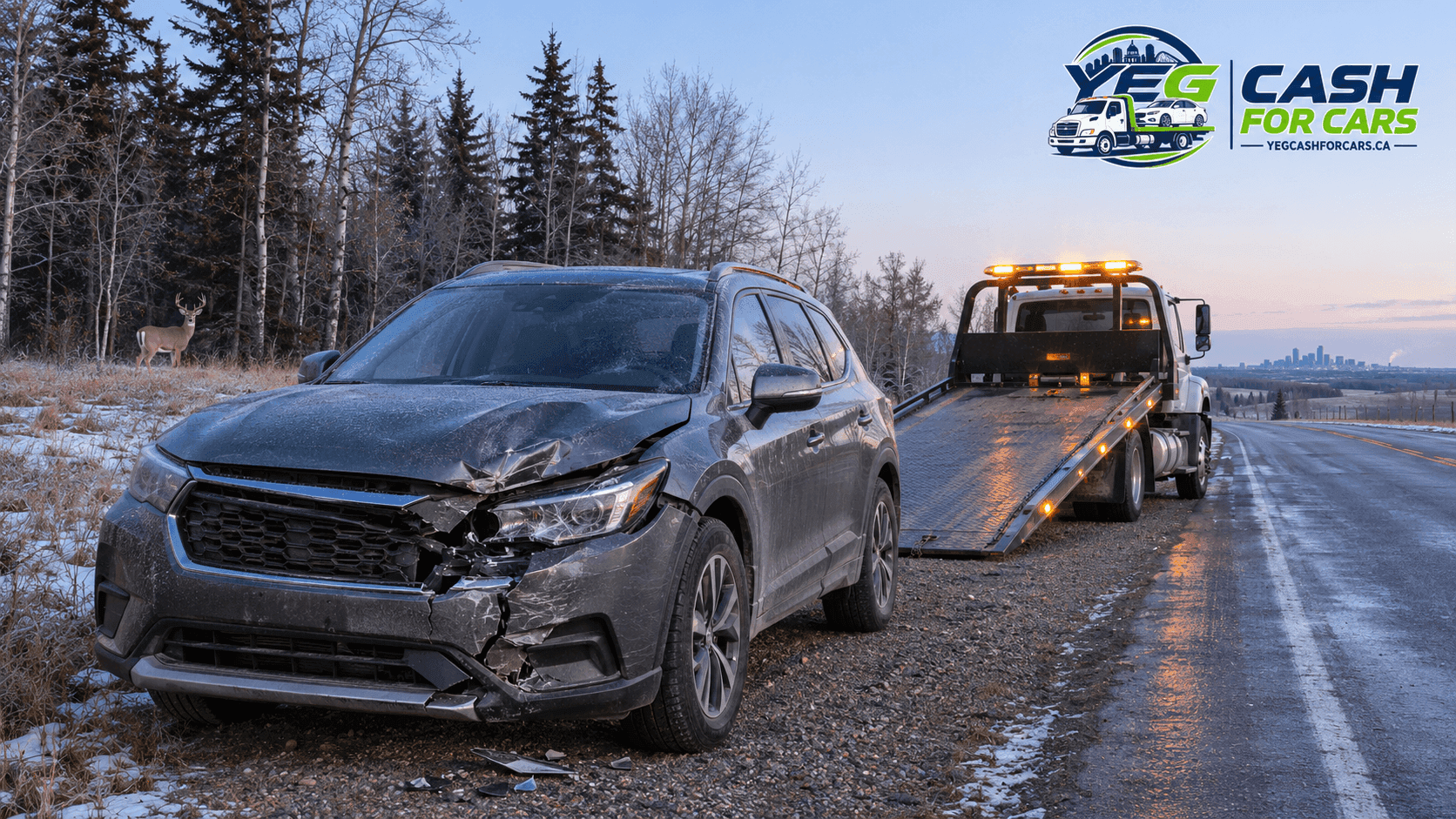
One second the road is clear. The next, a deer steps out of the ditch on Highway 16 at dusk, and there's nowhere to go. If it's happened to you, you're far from alone. According to the Alberta Motor Association, about 80% of wildlife collisions in Alberta involve deer, the average claim is around $8,000, and November is the peak month.
Deer aren't only a rural problem. They move through the North Saskatchewan River valley and the city's ravines, and they cross the Anthony Henday, the Whitemud and the highways out to Spruce Grove, Sherwood Park, St. Albert and Leduc.
This guide covers what to do at the scene, when you have to report the collision, what insurance pays for, and how to decide whether to repair the car or sell it.
Right After You Hit a Deer
- Pull over safely and turn on your hazard lights. On a highway, get as far onto the shoulder as you can.
- Check everyone in the car. If anyone is hurt, call 911.
- Stay away from the animal. An injured deer can kick hard enough to seriously hurt you. If it's alive or blocking the road, call 911 and let police handle it.
- Photograph everything: the damage, the road, the animal if it's safe to do so, and any skid marks.
- Look under the front of the car for leaking coolant or oil before you drive anywhere.
Don't drive away if:
- A headlight is out and it's dark.
- The hood won't latch or is bent up.
- Coolant is leaking or the temperature gauge climbs.
- Any airbag went off.
- The car pulls hard to one side.
In those cases, call a tow. Driving with a punctured radiator can cook the engine in a few kilometres and turn a body repair into an engine replacement.
Do You Have to Report It?
In Alberta, you must report a collision to police if anyone is injured, or if the estimated property damage is more than $5,000. That threshold went up from $2,000 on January 1, 2024. With the average deer claim around $8,000, many deer hits are over the limit. If you're not sure, report it. Your insurer will probably want the police report anyway.
Does Insurance Cover Hitting a Deer?
It depends on what happened and what coverage you have:
| What happened | Coverage that usually applies |
|---|---|
| You hit the deer | Comprehensive or all perils |
| You swerved and hit a ditch, guardrail or another car | Collision, and it may count as at fault |
| You only have liability coverage | Nothing for your own car |
That's why safety experts say to brake hard and stay in your lane instead of swerving. Swerving can turn a comprehensive claim into an at-fault collision, and it's more likely to cause a rollover or a head-on crash.
You'll usually pay your deductible. Hitting an animal generally isn't treated like an at-fault accident, but policies differ, so ask your insurer or broker how a claim affects your renewal.
The Damage You Can't See
Deer hit at bumper and hood height, which is exactly where modern cars pack their most expensive parts. The bent bumper is the obvious damage. Behind it, check for:
- A cracked radiator or air conditioning condenser.
- Broken headlight housings, which can cost far more than you'd expect on newer cars.
- A bent hood latch, core support or bumper reinforcement.
- Damaged parking sensors, cameras or the radar unit for adaptive cruise control.
- Airbag sensors and deployed airbags, one of the most expensive repairs on any car.
- Bent steering or suspension parts that throw off the alignment.
A collision shop will find most of this during a teardown. If you're paying yourself, ask for a full estimate before you approve any work.
When a Deer Hit Writes the Car Off
Insurers write a car off when the repair costs more than the car is worth. On an older vehicle, a deer hit that cracks the radiator, breaks both headlights and deploys the airbags can do that easily.
If your car is written off, the insurer pays you its actual cash value, minus your deductible, and usually takes the car. If you're offered the option to keep it, think carefully. A written-off car in Alberta may get a salvage status that requires an inspection before it can be registered again, and that status lowers its value for good. Our Alberta car selling paperwork guide explains how salvage status works and what you need to sell a car that has one.
No Comprehensive Coverage?
This is common on older cars around Edmonton. Your options:
- Repair with used parts. Salvage-yard headlights, bumpers and radiators can cut the cost a lot.
- Fix only what's needed to be safe. Lights, the radiator and the hood latch matter most. Cosmetic dents can wait.
- Sell it as it is. If the estimate is close to what the car is worth, this is usually the better move.
Repair or Sell?
| Your situation | Usually the best move |
|---|---|
| Newer car, comprehensive coverage, no airbags deployed | File a claim and repair |
| Light damage to the bumper and grille only | Get a cash quote, and consider used parts |
| Airbags deployed on an older car | Expect a write-off, or sell |
| Radiator cracked and the engine overheated | Get the engine checked before deciding |
| No comprehensive coverage and the estimate is near the car's value | Sell it as it is |
Selling a Car With Deer Damage
Front-end damage doesn't wipe out a car's value. If the engine, transmission and interior are fine, those parts are worth something, and trucks and SUVs hold their value especially well because their parts are always in demand around Edmonton.
We buy deer-damaged cars, trucks and SUVs as they are, including ones with deployed airbags and ones that can't be driven. Our page on cash for junk and damaged cars explains how we price vehicles like yours.
Lower Your Risk Next Time
- Be most careful at dawn and dusk, especially from October to December.
- Scan the ditches as well as the road, and use your high beams when there's no oncoming traffic.
- Where there's one deer, expect more behind it.
- Slow down where you see wildlife warning signs and near river crossings.
- If a collision can't be avoided, brake firmly and stay in your lane.
Frequently Asked Questions
Is hitting a deer considered an at-fault accident?
Usually not, when you hit the animal and it's claimed under comprehensive coverage. Swerving into something else can change that. Ask your insurer about your specific policy.
Can I keep driving a car that hit a deer?
Only if the lights, hood, radiator and steering are all working properly. If you're unsure, have it towed and inspected first.
Will you buy my car before the insurance claim is settled?
Talk to your insurer first. Once you've decided not to claim, or the claim is closed and you still own the car, we can give you a firm offer.
Turn a Wrecked Front End Into Cash
If the repair quote doesn't make sense, you don't have to keep a damaged car in the driveway. Send us the year, make, model and photos of the damage, and get a free quote from YEG Cash For Cars. The quote is what we pay, towing is free anywhere in the Edmonton area, and you're paid on the spot.