
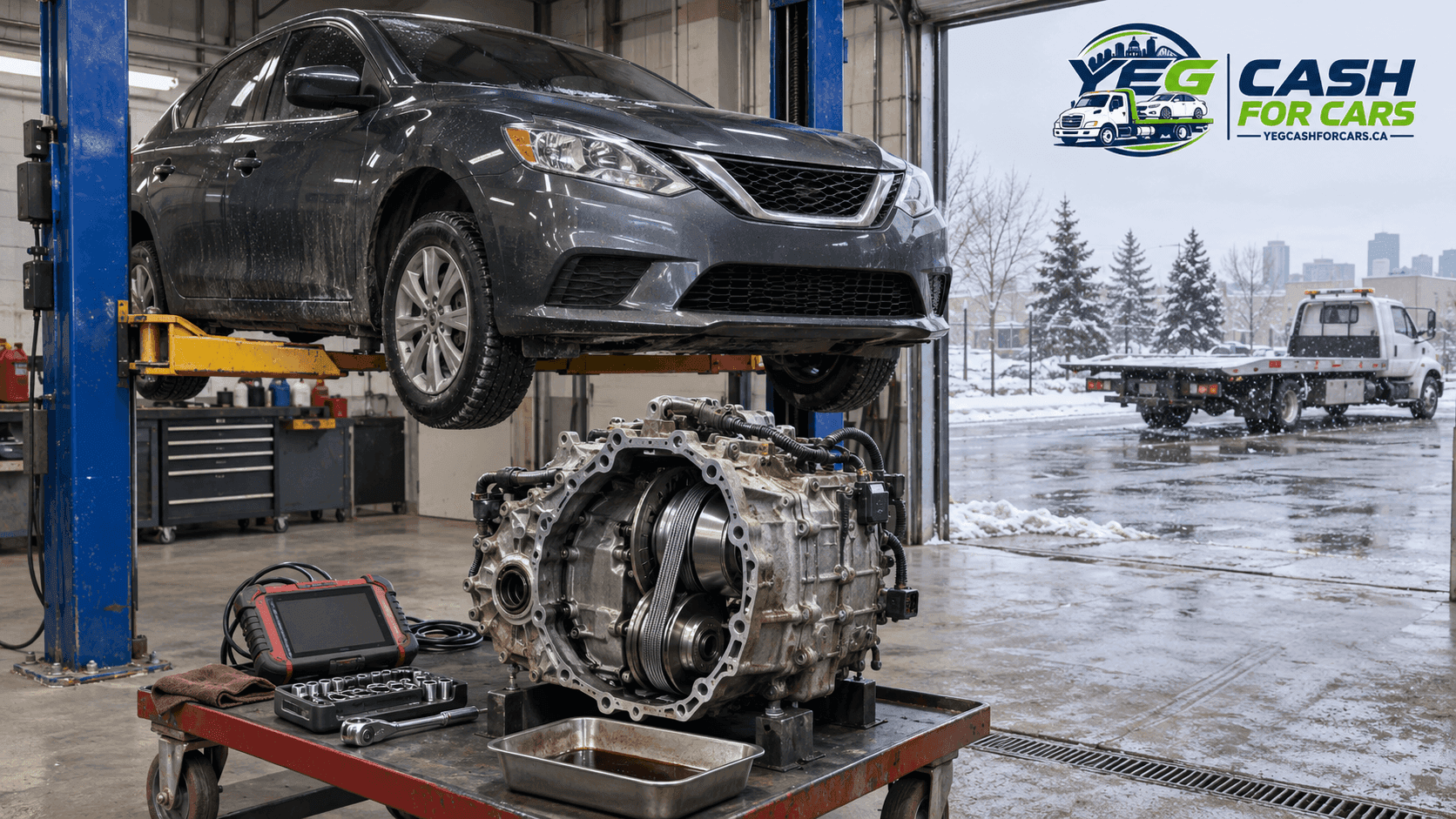
It usually starts small. Your Rogue shudders a little pulling away from a light on 170 Street, or the engine drones louder than it used to merging onto the Henday. Then one morning the dash lights up, the RPM won't climb and the car crawls along in limp mode.
If you drive a Nissan built in the last fifteen years, there's a good chance it has a continuously variable transmission, or CVT. Many of them have had a reputation for failing early. This guide helps you figure out whether yours is actually failing, what coverage to check before paying anything, and whether to fix the car or sell it.
Which Nissans Use a CVT?
Nissan has used its Xtronic CVT across most of its lineup. The models most often named in Canadian complaints and lawsuits include:
- Rogue (2010 to 2018)
- Altima (2010 to 2018)
- Sentra (2010 to 2019)
- Versa and Versa Note (2010 to 2019)
- Pathfinder (2013 to 2019) and Murano (2010 to 2019)
- Juke (2011 to 2017), Maxima, Quest, Cube and NV200
Not every one of these will fail, and plenty reach high kilometres without trouble. But if yours is on the list and showing the symptoms below, take them seriously.
Warning Signs of a Failing CVT
- Shudder or judder at low speed, especially between about 20 and 40 km/h. It can feel like driving over rumble strips.
- Whining or droning that gets louder as you speed up.
- Slipping: the engine revs climb but the car doesn't speed up to match.
- Hesitation when you press the gas from a stop.
- Limp mode: power is cut and the RPM is capped to protect the transmission.
- Overheating warnings after highway driving, towing or long climbs.
- Trouble codes such as P17F0, which Nissan connects to CVT judder.
Cold weather makes some of these symptoms worse. CVT fluid thickens at minus 30°C, so a transmission that's already weak often shows its problems first on a January morning.
Rule Out the Cheaper Fixes First
A shudder doesn't always mean a dead transmission. Before you accept a replacement quote, ask the shop to check:
- Fluid level and condition. Nissan CVTs need a specific fluid. Low, burnt or wrong fluid causes many of the symptoms above.
- Software updates. Nissan has released service bulletins that reprogram the transmission control module for some judder problems.
- The CVT cooler and valve body. On some models, these parts can be repaired or replaced without replacing the whole transmission.
Ask for the trouble codes in writing and ask whether any service bulletin applies to your VIN. A shop that recommends a full replacement without checking these isn't giving you the full picture.
Check for Coverage Before You Pay
Three things could reduce what you pay:
- Your powertrain warranty. If the car is still within Nissan's original powertrain coverage, the transmission should be covered. Check your warranty booklet or call a dealer with your VIN.
- The Canadian class action settlement. A settlement approved in March 2022 covers owners outside Quebec of the 2013 to 2016 Altima, 2013 to 2017 Juke, 2013 to 2017 Sentra, 2012 to 2014 Versa and 2014 to 2017 Versa Note. The available benefits and any deadlines are listed at cvtsettlementcanada.ca, so check there before you pay for a repair.
- Goodwill. If your car is just outside warranty and has dealer service records, ask Nissan Canada for a goodwill contribution. It's not guaranteed, but it costs nothing to ask.
Your Repair Options
| Option | Cost | What to know |
|---|---|---|
| New CVT from a dealer | Highest | Comes with a parts warranty, but the price often approaches the car's value on older models. |
| Remanufactured CVT | Middle | Rebuilt to a standard with its own warranty. Ask how long the warranty lasts and whether labour is included. |
| Used CVT from a salvage yard | Lowest | Unknown history. It may be from the same model years with the same weaknesses. |
| Partial repair (valve body, cooler, software) | Varies | Only works if the diagnosis supports it. Ask what happens if it doesn't fix the problem. |
Get at least two written quotes, and make sure each one includes parts, labour, fluid and any programming.
The Repair-or-Sell Math
Here's a simple way to decide. First, find out what your car would sell for if the transmission worked. Then compare that number with your repair quote.
For example, say your Rogue would be worth $7,000 with a healthy transmission, and the cheapest quote you trust is $4,500. You'd be spending more than 60% of the car's value on one repair. And the rest of the car is still the same age, with the same kilometres, the same rust from Edmonton's salted roads and the same suspension worn from pothole season.
As a rule of thumb, selling usually makes more sense when:
- The repair costs more than half of what the car would be worth running.
- The car has more than about 200,000 km.
- The only quotes you can afford are for used transmissions with no history.
- Other big repairs are coming, such as tires, brakes, rust or suspension.
- You've already replaced the CVT once.
Repairing usually makes more sense when the car is newer, in good shape otherwise, covered by a warranty or settlement, or paid off and you plan to keep it for years.
Don't Keep Driving on a Failing CVT
It's tempting to drive until it quits. The risk is that it quits somewhere bad: in limp mode on the Henday at rush hour, or on a dark stretch of Highway 16 at minus 25. Continued driving can also turn a repairable problem, such as a cooler or valve body, into a full replacement. If the symptoms are getting worse, park it and decide.
Questions to Ask the Shop
- What trouble codes did you find, and what do they mean?
- Did you check the fluid, software and any service bulletins for my VIN?
- Is this a new, remanufactured or used transmission?
- What warranty comes with it, and does it cover labour?
- Is anything else on the car about to need work?
Selling a Nissan With a Failed CVT
A Nissan with a dead transmission still has value. The engine, body panels, interior, wheels and catalytic converter are all worth something. The Rogue, Altima and Sentra are among the most common cars on Edmonton roads, so their parts sell well.
What helps your offer:
- A complete car with the engine still in it.
- Body and glass in good condition.
- An honest description of the symptoms when you ask for a quote.
- Your service records, if you have them.
Private buyers are usually wary of a car with known transmission trouble, and dealers often offer very little on a trade-in. We buy Nissans with failed CVTs as they are, whether the car still limps along or won't move at all. You can read more about how we buy non-running and broken-down cars, including cars stuck in limp mode.
Frequently Asked Questions
Should I change the CVT fluid before selling?
No. If the transmission has already failed, new fluid won't change what it's worth, and a buyer will price it as a failed transmission anyway.
Can I sell a Nissan that's stuck in limp mode?
Yes. We tow it, so it doesn't matter whether it can be driven.
Are newer Nissan CVTs more reliable?
Nissan made changes to its CVTs in later model years, and many owners report fewer problems. Check the history of the specific model and year before you buy another one.
Get a Firm Offer on Your Nissan
Don't put thousands into a transmission for a car you were already thinking about replacing. Tell us the model, year, kilometres and symptoms, and we'll give you a firm offer. The quote is what we pay, towing is free, and we can often pick up the same day. When you're ready, you can sell your car for cash in Edmonton without spending another dollar on repairs.